Video + Screen
Finalised Film
7 Minute Mandala
Week 1
Stop Motion Drawing
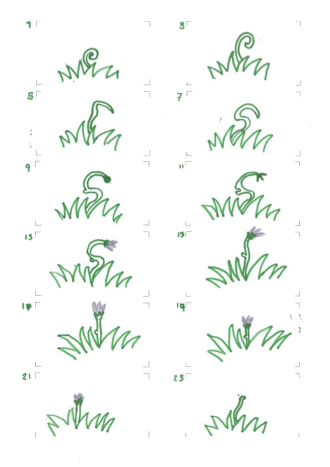
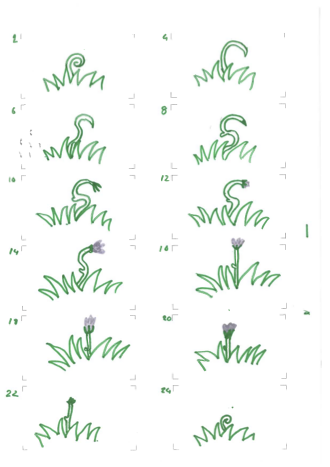
In Week One, we created 20-frame stop motion videos and learned how to use Premiere Pro to compile them. I had never used Premiere before, so there was a steep learning curve.
Week 2
Introduing Video Media
For the third sequence, I experimented with effects. I used nature videos from my phone and mirrored them, which created a disorienting, wiggly result that I really liked. I then added my stop motion animation again, this time also mirrored, first once, and then twice. This created a sharp, jagged shape that reminded me of a monster’s teeth.
In Week Two, I used my phone to compile short videos, along with my stop motion animation, to create three sequences.
Two of these sequences share a similar style. I layered videos and used the Colour Key tool to remove parts of the top layer, revealing the footage beneath. I used videos of fireworks and watercolor spreading, as I was drawn to the expansive, flowing movement in both. After layering them, I added my stop motion animation on top to further build visual complexity.


Week 3
Editing Video Media
Over the break I played with more stop motion in procreate. Using a mandala painting I made last year I added to the existing image using procreates stop motion feature. I then exported my animation to premier and used the colour key to select the background of the mandala and remove it.
A few years ago, there was a TikTok trend where people set their childhood videos to Hans Zimmer’s Cornfield Chase (from the Interstellar soundtrack), adding an echo effect to the sound. The music had a huge impact on the overall mood of the video. To me, it feels cosmic and spiritual, so I thought the TikTok video would work well with my mandala animation.
A Colour Box
Len Lye, A Colour Box, 1936, direct animation on 16mm film.
Len Lye’s A Colour Box (1936) is a vivid example of visual music. His abstract, energetic film was made by painting and scratching directly onto film stock. Lye’s process embraced spontaneity, rhythm, and a sense of joyful chaos, creating movement that’s disorienting but alive. His approach to motion and color strongly influenced my own video work, where I layer and mirror footage to create similarly unpredictable, immersive visuals. Like Lye, I aim to evoke feeling through visual complexity, letting disorientation become part of the viewer’s experience.
Cavalier, Stephen. 2016. “100 Greatest Animated Shorts / a Colour Box / Len Lye.” Skwigly Animation Magazine. February 18, 2016. https://www.skwigly.co.uk/100-greatest-animated-shorts-colour-box-len-lye/.
Mountain Castle Mountain Flower Plastic
Annapurna Kumar, Mountain Castle Mountain Flower Plastic, 2020, digital animation.
Annapurna Kumar’s Mountain Castle Mountain Flower Plastic uses disorienting imagery and intense color to create a hypnotic, fractured experience. The shifting grid, surreal juxtapositions, and sudden transitions, such as mountains morphing into rooms, feels like glitches in memory or vision. It made me think about how both human and computer memory store and retrieve information, and how fragmented visuals can still evoke a complete sense of place or emotion. This connects to my own work, where I explored memory through childhood videos, thinking about which moments we choose to hold onto, and how those memories distort, layer, and resurface over time.
Foreman Gallery. 2024.“Mountain Castle Mountain Flower Plastic – Foreman Art Gallery.” Foreman Art Gallery. April 13, 2024. https://foreman.ubishops.ca/videotank-31-mountain-castle-mountain-flower-plastic/.
International Film Festival Rotterdam. 2018. “Mountain Castle Mountain Flower Plastic.” IFFR EN. 2018. https://iffr.com/en/iffr/2018/films/mountain-castle-mountain-flower-plastic.
You or Me
Nicci Haynes, You or Me, 2020, digital video with hand-drawn animation.

I like how Nicci Haynes combines video stills of herself dancing with hand-drawn animation to create a layered, multimedia video. In You or Me (2020), two dancers under white sheets are outlined in animated drawings, first merging as one body before splitting into two. Haynes describes how she could intuitively capture her own movements but struggled to connect as easily when drawing over others. This responsive process reminds me of my own stop-motion animation, where I had to constantly adjust frames for a seamless flow. In both our works, the visible jolts and drawn marks highlight the human touch behind the animation.
Saskia Scott writing on Nicci Haynes’ exhibition – https://www.anca.net.au/blog-content/2020/9/30/peephole-cinema-nicci-haynes
Week 4
Finalising Video
During the critique, I explained that I had made the mandala artwork last year, exploring themes of the universe, reincarnation, and spiritual energy. However, no one picked up on that, as the artwork had been modified and was shown outside the context I intended when creating it. Some people said my first mandala video felt like a disorientating psychedelic trip, and others said it reminded them of the idea that when you die, your brain replays all your memories in seven minutes.
Taking this feedback, I re-drew and simplified the mandala animation to make it clearer and used a stock image of stars as the background to better convey the themes of energy and the universe. I also titled the video 7 Minute Mandala to confirm the idea of it being a flashback of life when you die. I used baby videos specifically because I feel it’s slightly easier to project your own experiences onto vague baby footage than onto specific moments from my life.
Premire Timeline
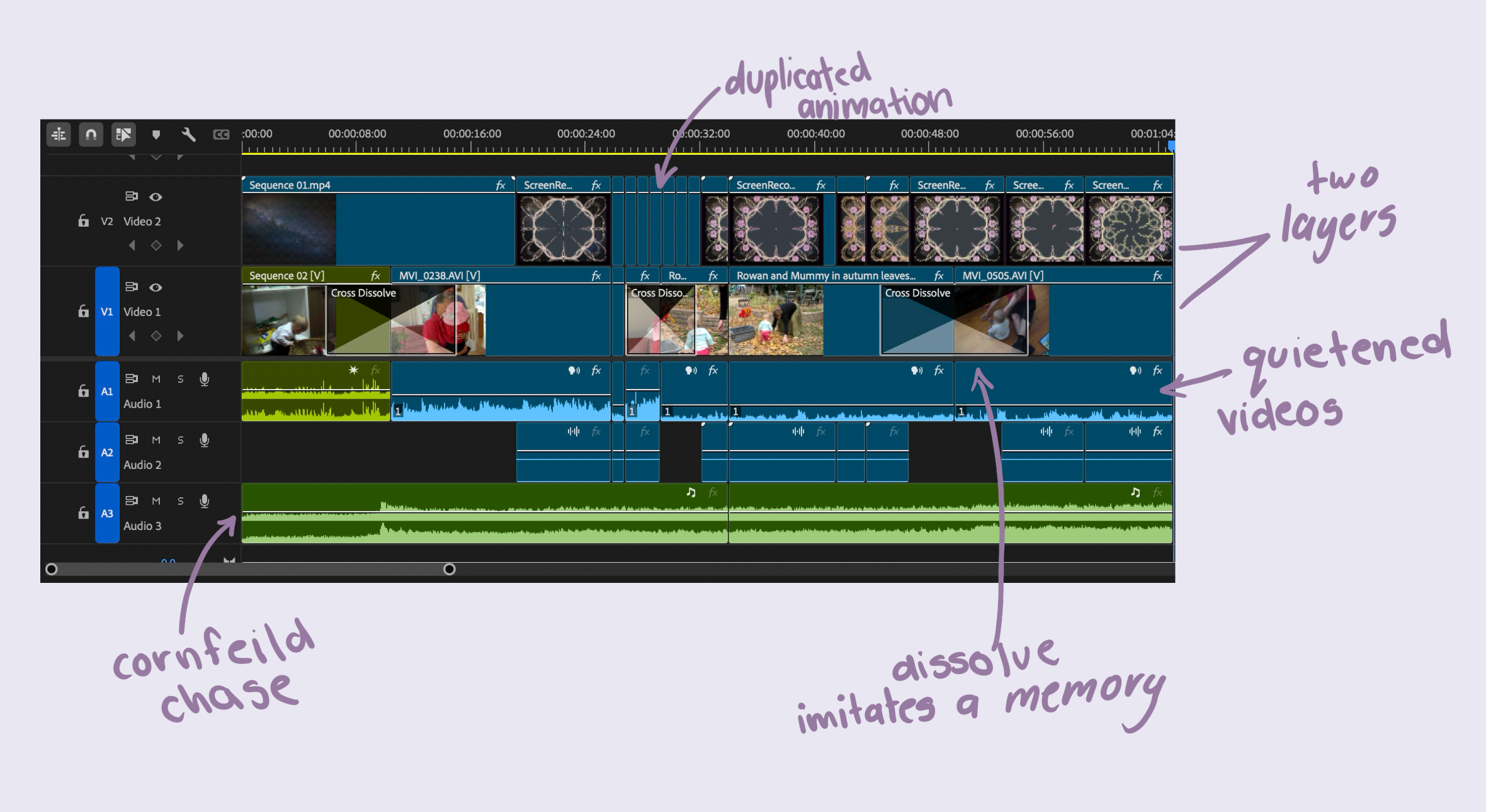
Most of the time I was working on my video, I was so excited to put it all together that I rushed the animations. If I were to go back and remake the video, I would spend more time on the animations and make them more complex and visually interesting. I think the title is very fitting, but everyone I have shown it to has asked, before seeing the video, “Why is it only 1 minute and not 7?” That’s because 7 minutes of animation is more than ten thousand frames, my measly 800 was enough for me, and the criteria was only for one minute. I would love to make an extended version of the film, using more footage from across my life in chronological order, with more obvious, fleshed-out symbols and imagery in the animation.
Love Is the Message, The Message Is Death
Arthur Jafa, Love Is the Message, The Message Is Death, 2016, Single-channel digital video
In Love Is the Message, The Message Is Death (2016), Arthur Jafa creates a film that feels relentless. The quick cuts and constant visual stimulation don’t allow you to look away, not even for a second. The clips of Black people dancing and expressing themselves, violently juxtaposed with footage of police brutality against African Americans, is especially confronting. Most of the video is made up of found footage Jafa pulled from across the internet: scenes from the Civil War, contemporary moments of Black enjoyment, weddings, protests, everyday life, and flashes of the sun burning. The background music, Kanye West’s Ultralight Beam, resonates immediately. Something about Kanye’s music always touches the soul, and here it carries an almost spiritual weight. The curator of the 2017 showing at the Museum of Contemporary Art in Los Angeles, Helen Molesworth, said the film “suspends viewers” in an emotional state, forcing them to confront their own beliefs about race and the complex, painful space African Americans occupy in American society. And she’s right, watching it, you can’t look away, the quick pace of images leaves you in complete awe of the work’s beauty and horror.
The Metropolitan Museum of Art. 2022. “Love Is the Message, the Message Is Death – Arthur Jafa – American.” Metmuseum.org. 2022. https://www.metmuseum.org/art/collection/search/746246.
Johnson Museum of Art, Cornell University. 2025. “Arthur Jafa: Love Is the Message, the Message Is Death – Herbert F. Johnson Museum of Art.” Herbert F. Johnson Museum of Art. February 10, 2025. https://museum.cornell.edu/exhibition/arthur-jafa-love-is-the-message-the-message-is-death/.
The Reflecting Pool
Bill Viola, The Reflecting Pool, 1977–79
Color videotape
In the film The Reflecting Pool (1977–79), a man dives into the water but his motion is suspended, and he remains frozen in a fetal position in the air as the pool in front of him and the forest around him continue moving naturally, slowly getting darker. Throughout the video, Viola’s body gradually fades until he disappears, and later, a man climbs out of the water and disappears into the forest. I find how early video works like this were made very interesting, especially how much time and care must have been taken to ensure that the still images lined up correctly without digital editing. The Reflecting Pool was extremely complex to produce at the time, Viola used a fixed camera and carefully faded several shots together to create seamless transitions between stillness and motion. The natural sounds in the video, with a slight echo, create a mystical and sometimes spooky mood. I also found it really moving that this piece reflects ideas about time, memory, and transformation.
Guggenheim Museum . n.d. “The Reflecting Pool, 1977–79 | Guggenheim Museum Bilbao.” Guggenheim Bilbao. https://www.guggenheim-bilbao.eus/en/learn/schools/teachers-guides/reflecting-pool-1977-79.
The Art Institute of Chicago. n.d. “The Reflecting Pool: Collected Works – Bill Viola.” The Art Institute of Chicago. https://www.artic.edu/artworks/108765/the-reflecting-pool-collected-works.
The Galaxy
Sabin Bălașa, The Galaxy, 1973, hand-painted animation on film.
Sabin Bălașa’s work is deeply visionary, blending dreamlike, symbolic imagery with a belief in art as a spiritual gift to humanity. In his hand-painted film The Galaxy (1973), each frame evokes unease and wonder through surreal visuals of the universe, the human form, plants, and space which reflecting his themes of beauty, freedom, and a shared cosmic dream. His use of unconventional, emotionally charged imagery to express spiritual and universal ideas resonates with my own practice, where I convey intangible truths through layered, unexpected visuals.
Balasa, Tudor. 2025. “SABIN BALASA – Offical Website.” Sabinbalasa.com. 2025. https://www.sabinbalasa.com/works/animation/.